At the till
A shop can put a sign like this on its door. Under the sign, the shop can show the banks whose apps pay with a tap.
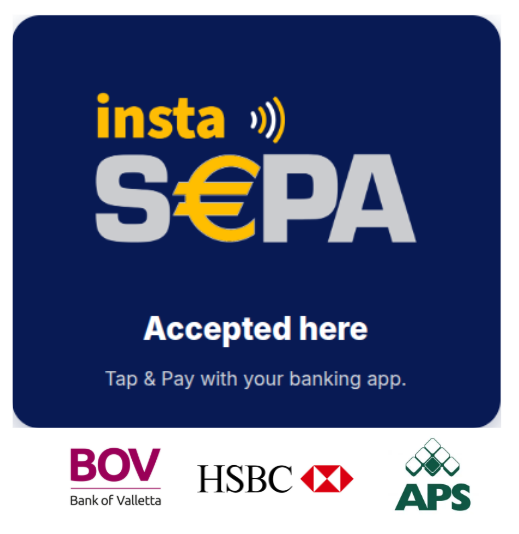
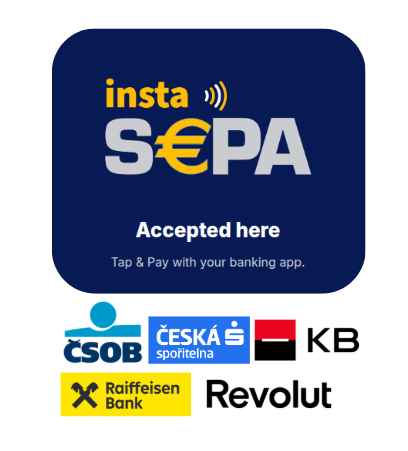
Illustration only. The bank logos are examples of how a shop could show them. They do not mean that these banks take part in instaSEPA.
Other use cases
Other payments use the same parts and are easier to build. Here are six examples.
Failed direct debits
A SEPA Direct Debit can fail if the account has too little money on the due date. The creditor can then send a Request-to-Pay to the same account. If the payer approves it in the banking app, SCT Inst moves the money in seconds.
Request-to-Pay to the payer's IBAN, paid by SCT Inst.
Subscriptions
A service can bill a customer each month with an account-to-account payment. It sends one Request-to-Pay for each period. The customer approves the 1st one in his banking app. Then if the customer selects "auto approve future RTP from this IBAN" in his banking app the subscription is collected automatically each month via auto-approved SRTP.
One Request-to-Pay per billing period.
Cash at the ATM
The customer taps the phone on the cash machine and confirms the amount on the phone. A few seconds later, the money reaches the ATM operator. Then the machine pays out.
NFC tap with a disposable vIBAN, then Request-to-Pay and SCT Inst.
B2B invoices
Each invoice gets its own virtual IBAN. The customer pays by SCT Inst, and the money arrives in seconds. The accounting system uses the virtual IBAN to match each payment to its invoice automatically.
One vIBAN per invoice, and a Request-to-Pay with the invoice reference.
Large purchases
Some purchases are large, for example a car service, a bike, a home appliance or a car. A card limit can be too low for an amount like this. After the buyer approves the Request-to-Pay, SCT Inst moves the full amount in seconds, within the buyer's own transfer limit. Before that, the buyer's bank checks that the seller's name matches the IBAN.
Request-to-Pay with Verification of Payee, paid by SCT Inst.
Local taxes
A town hall sends a Request-to-Pay for property tax or a parking fine. The citizen pays from the banking app. The payment arrives with its reference, so the town hall books it at once. At the counter, the citizen can also pay with a tap.
Request-to-Pay with a structured reference, or an NFC tap at the counter.
Built on SEPA standards
Any case that card schemes cover today can work with the same experience for the user. The money moves by SEPA Instant Credit Transfer. The other parts are:
- SEPA Request-to-Pay (SRTP). The payee sends a request and the payer approves it in the banking app.
- Virtual IBANs. Each invoice or terminal can have its own IBAN. The payee then matches each payment automatically.
- Verification of Payee. Before the payer approves, the payer's bank checks the payee's name against the IBAN.
- NFC. With a tap, the phone sends a disposable vIBAN to the till. instaSEPA works also OFFLINE for the payer device.
- QR codes. The fallback for phones without NFC.